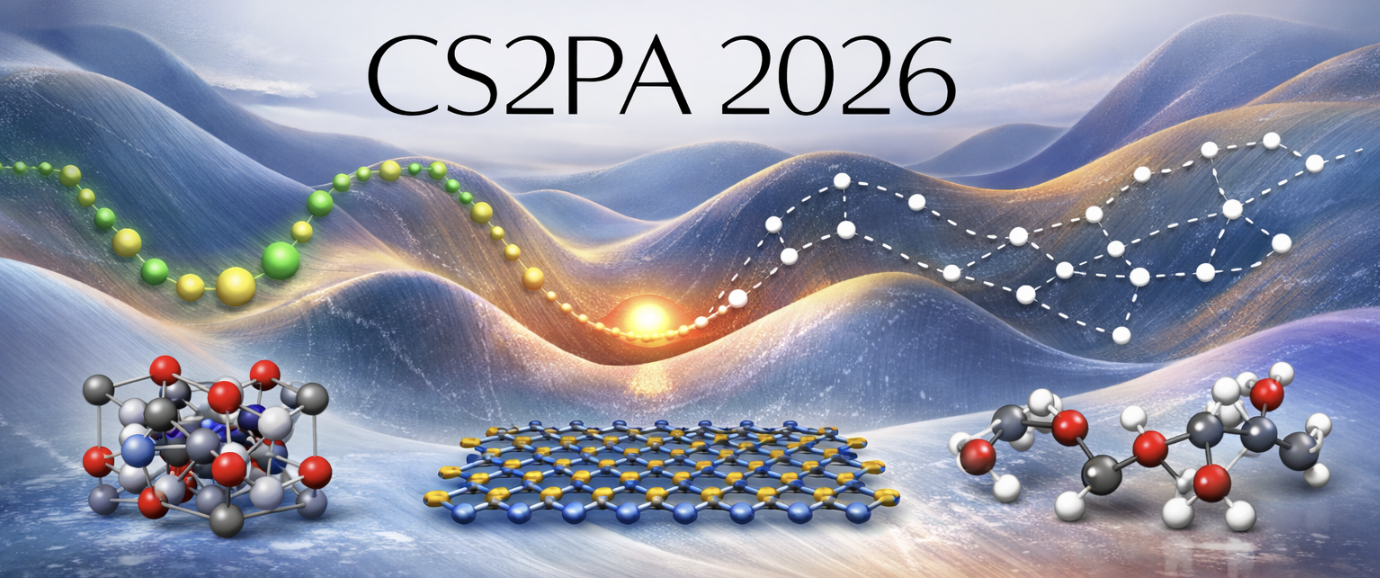
We are happy to announce the seond edition of CS2PA 2026 workshop, a series of hands-on tutorials on Crystal Structure Prediction & Machine-learned potentials. The worshop will be held from 1 to 5 june 2026 in Poitiers University (France). Registration is open online.
The workshop aims to introduce two powerful methods for finding the global (and local) minima of a potential energy surface, an evolutionary algorithm and an ab initio random generator. These are implemented in XtalOpt and AIRSS codes, respectively. These CSP searches, combined with periodic DFT calculations (or other energy calculation approaches), are applied to bulk compounds, 2D materials, polymers and so on.
In addition, the hands-on tutorials will focus on the concepts and technical recipes for generating interatomic potentials to speed up the PES scan and allow the investigation of large unit cells, binary/ternary systems and phase diagrams. The machine-learning interatomic potential techniques integrated in the EDDP of the AIRSScode are presented.The workflow for combined use of generative models, machine-learning interatomic potential and DFT workflow for rapid screen of materials will also be presented (HT-workflow).
We have planned a 5-day workshop to practice these CSP codes combined with machine learned potentials and/or DFT calculations:
-
XtalOpt/MLIP of Pr. Eva Zurek et al
-
AIRSS/EDDP of Pr. Chris Pickard et al
-
HP-workflow of Pr. Qiang Zhu et al
Parallel sessions on BONDING ANALYSIS IN SOLIDS are offered to deeply understand the crystal structure of the predicted materials: conceptual DFT, ELF, Bader using the Critic code (Dr F. Guégan) & bands/DOS and COBI using the Lobster code (Pr. Gilles Frapper).
The CS2PA workshop will introduce the participants to the main concepts of this CSP field, and will focus in depth on the use of these CSP codes, the Machine Learned Interatomic Potentials machinery, and the HT-workflow. Dedicated (and home-grown) analysis tools will be presented.
Participants will have the opportunity to run their own simulations, to analyze the results and to discuss them with their peers.
Researchers with a proven experience in standard DFT and/or ab initio calculations can participate in this tutorial.
Daily lectures covering both basic and advanced topics will bridge the gap between theory and simulation, followed by tutorials where participants will use the CSP codes to search for crystal structures.
Participants will receive detailed tutorials on structure prediction for crystals, surfaces and nanoparticles, and how to analyze the rich data provided by this method using specially developed advanced tools .
Please note that a contributed poster session and short scientific presentations will be organized, with ample time for discussion and social events.
The number of places is limited to 30. A selection will therefore be made. Please register ASAP. Welcome to CS2PA 2026!
 Loading...